12+ updates and additions to kick off 2026
Feb 24, 2026
New versioning feature, plus product types added to flooring and countertops
Summary
Habitable is proud to release Informed Version 3 which includes the following guidance updates and new features:
- The flooring category includes seven (7) new product types, including biobased fluid-applied flooring (also called liquid linoleum). Some flooring product types shifted on the spectrum but none changed significantly.
- The countertops category includes five (5) new product types with one significant change in ranking. Quartz or engineered stone countertops fell from yellow to red.
- The assessment form has been updated to reflect the new guidance.
- A new feature enables users to access prior versions of product guidance and the assessment form. This is especially helpful for users who started a project using an earlier version.
You Asked, We Delivered
Based on Informed user feedback, we’ve updated and expanded two important product categories: Flooring and Countertops. The updates bring together new and past research to provide the most up-to-date and expansive guidance to date. We’ve filled many data gaps, adding seven product types to the flooring category and five to the countertops category. To select healthier product types, avoid those ranked red and prefer those ranked yellow and green.
Flooring Highlights
This update adds 7 new product types to the guidance:
- Sheep’s wool carpeting
- Quarry tile
- Portland cement terrazzo
- Polyacrylate terrazzo
- Epoxy terrazzo
- Biobased fluid-applied flooring (aka liquid linoleum)
- Pre-cast terrazzo
We also removed some of the variables (e.g. factory- versus site-finished) that were not significant differentiators in order to simplify the guidance. Some product types shifted on the spectrum but none changed significantly.
Liquid Linoleum Ranked Red
Notably, the newly added ranking for biobased fluid-applied flooring, also called liquid linoleum, shows that while this is often assumed to be a healthy option, it has many hazardous chemical impacts and is not a preferred product type (ranked red). While there are some content similarities with linoleum sheet or tile, this product type is very different—it contains asthmagenic isocyanates that react during installation and the installed product is more than 25% plastic.
Countertop Highlights
This update adds 5 new product types to the guidance:
- Butcher block/wood
- Sintered stone
- Stainless steel
- Recycled glass
- Phenolic resin (also called paper-composite countertops)
Quartz Countertops Fall to Red
There was one significant change of an existing product type ranking. Quartz or engineered stone countertops fell from yellow to red. While we have always considered impacts throughout the life cycle of products, including during manufacturing, new research suggests that quartz in engineered stone presents uniquely dangerous hazards for countertop fabricators.1–3 This new data, in combination with the addition of several healthier product types to the ranking, means that quartz or engineered stone countertops are no longer recommended. The most significant impacts of these countertops occur in manufacturing, so if you already have quartz countertops installed, there is no reason to remove them. However, we recommend you avoid cutting or grinding of these countertops that may generate hazardous dust.
For more details, check out the updated product guidance for flooring and countertops.
Already started a project with the prior version of Informed?
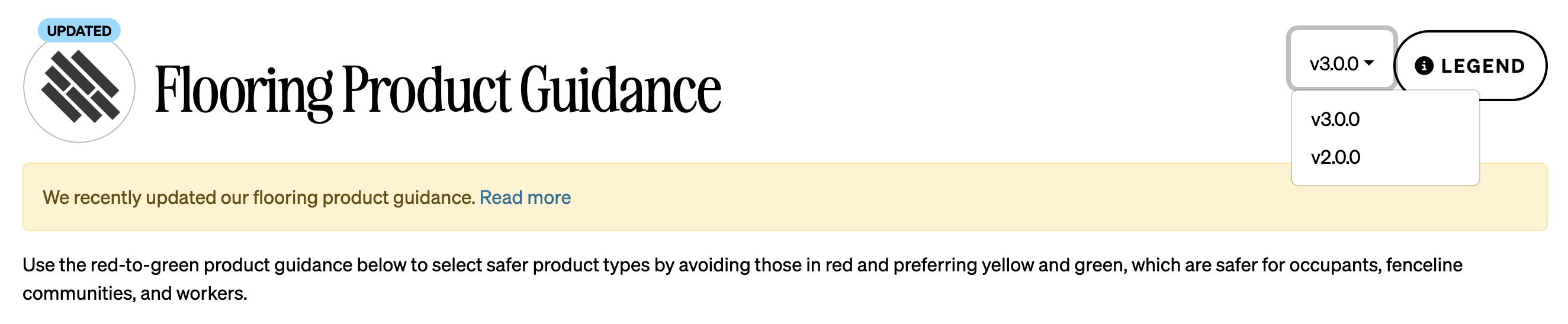
Informed product guidance uses versioning to better support projects in progress while allowing updates to our guidance over time as the market changes and our research uncovers more information. Major version releases (e.g. v3 compared to v2) include substantive changes to the assessment form and guidance such as new product types, new color rankings, or additional categories—so these updates count as a Major version change. Habitable recommends using a single Major release version throughout a given project for consistency, particularly if you are pursuing Informed-related credits within green building standards. The most recent version is shown on the Informed website by default, but you can select prior versions when you download an assessment form and at the upper right of each product guidance category page (see screen shot below). Note that a single version number applies to all product guidance categories. However, not all product categories are updated in each version.
Footnotes
(1) León-Jiménez, A.; Hidalgo-Molina, A.; Conde-Sánchez, M. Á.; Pérez-Alonso, A.; Morales-Morales, J. M.; García-Gámez, E. M.; Córdoba-Doña, J. A. Artificial Stone Silicosis: Rapid Progression Following Exposure Cessation. Chest 2020, 158 (3), 1060–1068. https://doi.org/10.1016/j.chest.2020.03.026.
(2) Wu, N.; Xue, C.; Yu, S.; Ye, Q. Artificial Stone‐associated Silicosis in China: A Prospective Comparison with Natural Stone‐associated Silicosis. Respirol. Carlton Vic 2020, 25 (5), 518–524. https://doi.org/10.1111/resp.13744.
(3) Ramkissoon, C.; Gaskin, S.; Thredgold, L.; Hall, T.; Rowett, S.; Gun, R. Characterisation of Dust Emissions from Machined Engineered Stones to Understand the Hazard for Accelerated Silicosis. Sci. Rep. 2022, 12 (1), 4351. https://doi.org/10.1038/s41598-022-08378-8.