Frequently Asked Questions
Welcome to Habitable’s Informed™ Frequently Asked Questions (FAQs). Here, you can read more about the Informed product guidance and how to get in touch with us.
Informed™ is Habitable’s product guidance that allows you to quickly and confidently select healthier building materials. More than 150 product types are ranked, using an intuitive red-to-green scale, based on the material health impacts of chemicals throughout a product's life cycle. By avoiding red-ranked and preferring yellow- and green-ranked product types, you can select healthier products while minimizing negative impacts on human and environmental health and supporting environmental justice.
| Color Ranking | Description | |
|---|---|---|
|
Green
|
Best in Class | Prefer. Fewer chemicals of concern or less hazardous chemicals throughout the product lifecycle. |
|
Light green
|
Better | |
|
Yellow
|
Good | Use but still opportunity for improvement. |
|
Orange
|
Reduce | Phase out or reduce amount used. |
|
Light red
|
Eliminate | Avoid. Most chemicals of concern or chemicals with the highest hazards used throughout the product lifecycle. |
|
Red
|
Worst in Class | |
|
Grey
|
Undetermined | Not yet researched |
Anyone! Informed is designed for anyone choosing building materials, especially those who influence material choices early in the design and construction process. Most commonly, it is used by architects, designers, developers, owners, procurement teams and sustainability consultants.
Informed helps project teams make healthier material choices quickly and confidently, using the red to green product guidance, saving time and cost. Especially when integrated during the early stages of design and construction—when it’s easiest and most cost-effective to influence material decisions. Furthermore, Informed can also be used for educating stakeholders about the impacts of building materials on human and environmental health, benchmarking current practice, and setting healthy material goals as early as the schematic design phase of the project.
To use the guidance, start by selecting a product category. Note that within each product category, product types are ranked from the worst in class to the best in class for that category. The next step is to identify the specific product type(s) under consideration (e.g. "Flooring" → "Ceramic Tile"), eliminating options that are red ranked and preferring those that are yellow and green ranked. Once the product types are selected, project teams can identify product(s) that are based on the chosen product type (e.g. "Flooring" → "Ceramic Tile (without added lead)" → “Product ABC by Manufacturer XYZ”). The Informed™ Assessment Form can be used to measure, track, and guide progress throughout design.
Note that Informed does not include recommendations for specific brands or products.
Using the benchmarking and assessment tools, project teams can create a baseline and establish healthy materials goals, systematically evaluate and track project progress against the baseline and communicate meaningful impact. Learn more about the benchmarking tools and explore our tutorial for a step-by-step walkthrough of the Informed Assessment Form.
Any stage. Informed is designed to be applied at any stage of a design and construction project, though has the greatest impact when integrated early in the design and planning phases. By using Informed during the conceptual or schematic design stage, project teams can establish clear goals for healthier material selection before specific products or manufacturers are chosen. Similar to energy modeling, the power of Informed is the ability to do early project modeling to assess and benchmark product specifications and set measurable goals for improving from the baseline (e.g. to avoid red-ranked product types) - resulting in selection of healthier products. Since many projects build on past project specifications or organization-wide base specifications, this assessment can also help improve outcomes not only for the current project, but also help set you up for success in healthier material selection for future projects as well.
Within the context of Informed, a Product Category refers to the broad grouping of building materials that serve a common function or purpose (Flooring, Insulation, or Countertops). Meanwhile, a Product Type is a classification within a given category that identifies a distinct form or material formulation used to fulfill that function. For example, within the Flooring category, product types may include vinyl sheet flooring, rubber tile flooring, or linoleum sheet flooring—each representing a different combination of materials and manufacturing processes that may pose different levels of human and environmental health concerns.
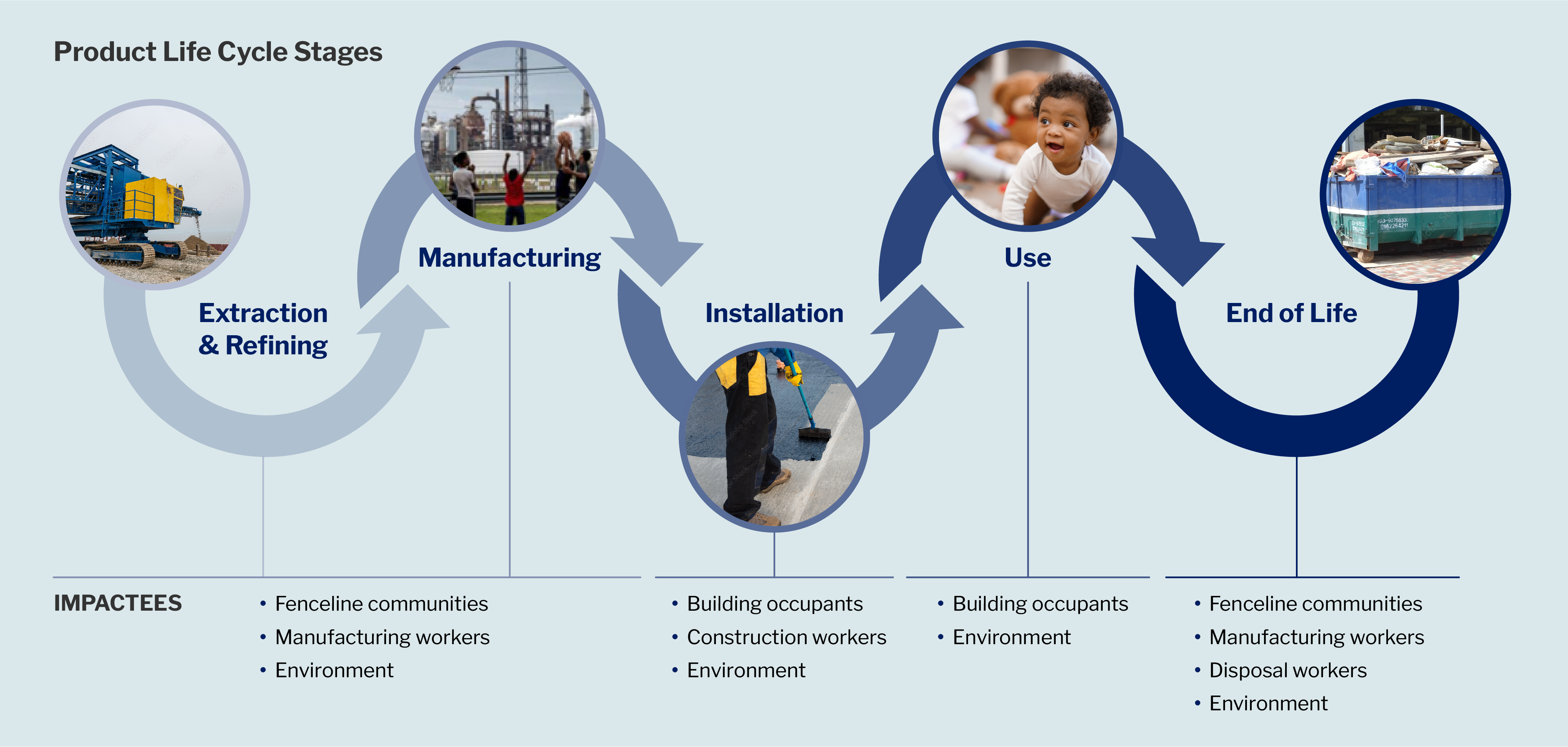
Informed product guidance is based on Habitable’s methodology grounded in over two decades of our in-depth research on building materials and their associated chemical hazards. Using six key evaluation criteria to assess material health, the methodology accounts for potential health impacts on people—including workers, fenceline communities, and building occupants—and the environment across all stages of a product’s life cycle.
The red-to-green ranking visualizes the results of the assessment, with each product type ranked from best (green) to worst in class (red). Learn more about the Informed Methodology and the steps by which the color ranking is determined.
Note that cost, performance, or full life cycle environmental impacts, such as those reviewed in a life cycle assessment (LCA), are not considered in this ranking.
Neither. Informed is not a certification or a rating system or a standard. It is a decision making framework for selecting healthier materials and provides guidance on product types within the product categories.
Informed serves a unique role in the current ecosystem of healthy materials frameworks and standards - by providing clear and easy to use guidance that helps project teams set strategic healthy material priorities and efficiently select product types aligned with those priorities. This is possible because of the following main reasons:
Product type approach: Informed is based on product types, guiding teams to the most impactful changes first that sometimes may entail shifting to a different product type altogether. This approach allows teams to then confidently select products within healthier product types efficiently, without needing to be a materials expert or evaluating every single product. Think of it like shopping the perimeter of a grocery store where choosing from a healthier option (vegetables) and eliminating the worst option (candy) will ensure better outcomes. The same is true of a product type approach to healthier building material selection.
Full life cycle impacts: Informed assesses material health impacts across the full life cycle - from extraction, manufacturing, occupancy to end of life - including impacts on occupants, workers, communities, and the environment. This allows project teams to achieve goals ranging from eliminating specific chemicals (e.g., PFAS, phthalates, carcinogens) to promoting broader healthy material outcomes (e.g., plastics reduction, protecting children's health) and simplifies the steps to achieve the relevant outcomes.
Independent: Grounded in Habitable’s independent research, Informed delivers an easy red-to-green ranking system to quickly identify healthier materials. Informed shifts the power from manufacturers to project teams/ decision makers.
For building industry practitioners who want to choose healthier materials but struggle to find clear, reliable data for making healthier material choices - Informed can be used to make healthy materials decisions early in the design process, when shifting to alternatives is easier and more cost-effective. By identifying product types first, the process of selecting products is significantly streamlined resulting in savings of effort and time. The ability to benchmark and assess product selections using Informed tools also enables project teams to measure their progress on healthier material selection over time and across projects.
No. Informed is not a product database and does not include product specific information including certifications or labels.
For product assemblies, it is advised to use the relevant product category guidance to review each component of the product assembly. For example, for a resilient floor assembly, start by referencing flooring product guidance to identify various flooring options ranked from red to green within the product category. For other components of the assembly such as sealants and installation, reference the guidance that addresses these categories (i.e. flooring installation and sealants). Eliminating red ranked product types and preferring yellow or green ranked product types for each of the components contributes to healthier material selections.
Yes. Currently, we are piloting credits based on Informed with many leading green building standards including Enterprise Green Communities and LEED. In addition, MN Overlay and WELL for residential standards have materials criteria that are based on using Informed. Find additional information on how to achieve these credits or criteria on the Informed Green Building Standards Integration page.
Creating an account is free and allows us to keep users informed about the latest updates to the guidance. It also helps us gather your input so we can continuously improve and evolve Informed.
If you have questions about Informed, feel free to contact us.